Loading…
Honest comparison
PAC — the desktop PDF accessibility checker, explained
PAC is the tool most accessibility professionals reach for when they test PDF/UA — and it only runs on Windows. Here’s what it does well, where it stops, and when a free browser-based checker is the more practical tool.
What PAC checks
PAC (PDF Accessibility Checker) is a free Windows desktop application from the PDF/UA Foundation, developed by axes4. It tests a PDF against the machine-checkable failure conditions of the Matterhorn Protocol— the industry’s testing model for PDF/UA-1 — plus a WCAG 2.1 AAcheck set (including color contrast) and, since PAC 2024, a set of “quality checks”: plausibility warnings such as a document with no headings or alt text that looks like a file name. PAC 2026 added AI-assisted structure warnings on top.
Beyond validation, PAC ships two genuinely excellent human-review tools: a logical structure viewer (browse the tag tree, inspect tag properties and role mappings, review artifacts) and the Screen Reader Preview, which renders the document in tag order — the way assistive technology actually walks it. If you remediate PDFs professionally on Windows, PAC belongs in your toolkit. It’s free, including for commercial use.
Its practical limits are just as clear: it runs only on Windows 10/11 (a Mac version has been announced as in development, but hasn’t shipped), it has no command line, no batch mode and no API — the vendor sells a separate product for automation — and its report exports as a PDF only, with no machine-readable output. Its license also doesn’t permit third parties to offer it as a hosted service — so a browser-based “PAC” from anyone but its makers isn’t something you should expect to find.
PAC vs the ReflowPDF checker
Different engines, same standard: PAC implements the Matterhorn Protocol’s machine checks; our checker runs veraPDF, the open-source reference validator, against the full PDF/UA-1 rule set. Where each is ahead today:
| Capability | PAC 2024/26 | ReflowPDF |
|---|---|---|
| PDF/UA-1 machine checks (Matterhorn) | ||
| Runs on Mac, Linux, ChromeOS, mobilePAC is Windows 10/11 only | ||
| No install, no sign-up | ||
| Exact issue locations drawn on the pagePAC shows a page snippet for context | ||
| Shows what passed (verified-on-N-objects) | ||
| Plain-English explanation + fix per rulePAC links UA errors to a Google search | ||
| WCAG 2.1 check set incl. color contraston our roadmap; we check PDF/UA today | ||
| Quality / plausibility warningsadvisory checks incl. alt-text review, heading jumps, table regularity | ||
| Tags tree & screen-reader previewtree with failures pinned to exact elements; tag-order preview + reading-order overlay | ||
| PDF/UA-2 & Well-Tagged PDF validationno PAC version validates UA-2; select it in our checker | ||
| Machine-readable results (JSON, API)PAC has no CLI/batch/API | ||
| File stays out of anyone's storagePAC is local; we validate in memory and delete immediately |
Table reflects PAC 2024/2026 official documentation and our live checker as of July 2026. If we’ve got something wrong, tell us and we’ll fix it.
Where a browser checker is simply more precise
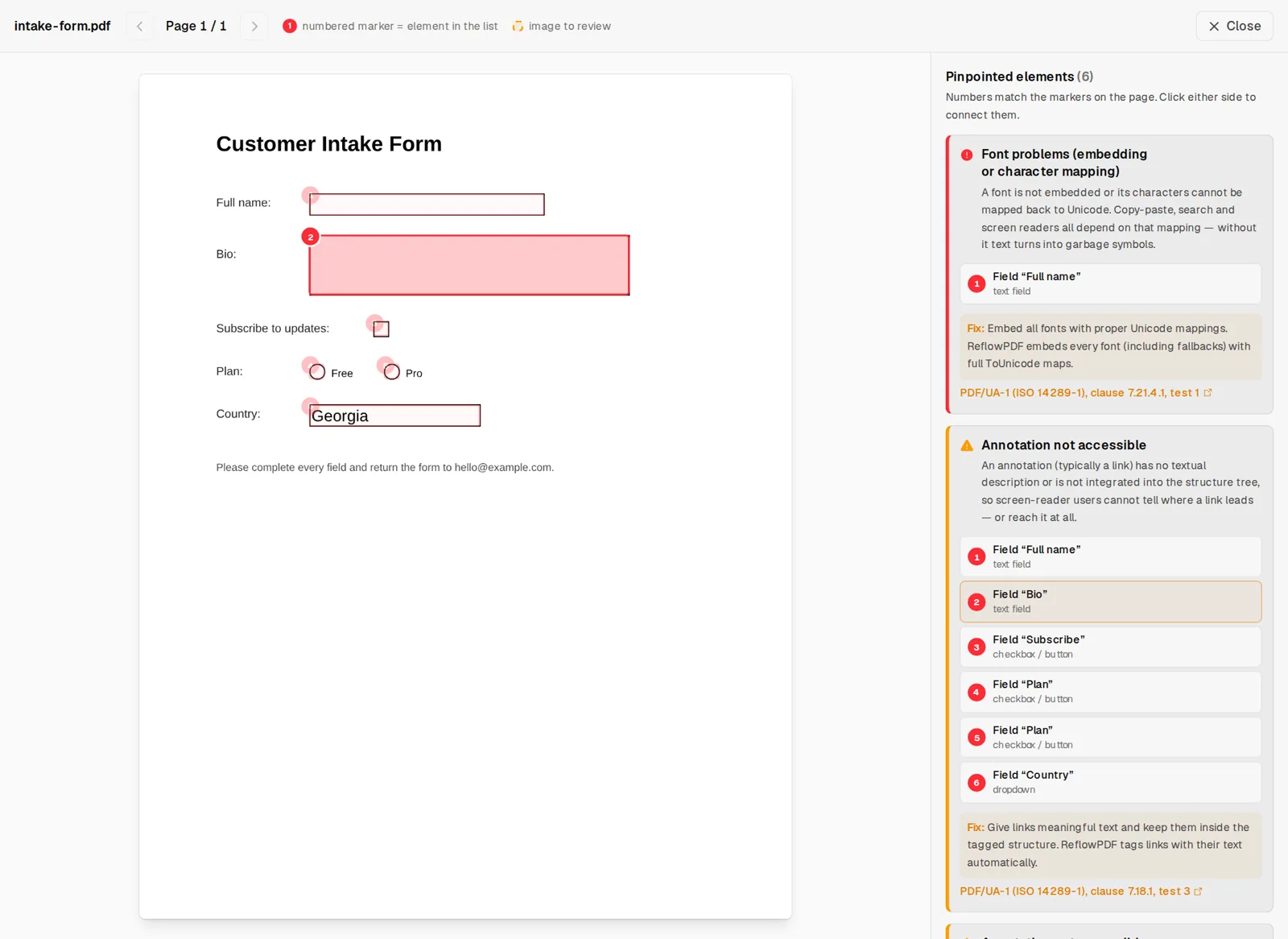
Because our checker renders your PDF right in the page, it can draw every finding on the document itself— numbered markers for each form field, link or image that fails a rule, synced with the explanation beside it. PAC’s detailed report shows the affected page as a snippet; you still hunt for the element yourself.
When to use which
Use PAC when…
- You work on Windows and remediate PDFs professionally
- You need its tags-tree viewer and Screen Reader Preview for deep manual review
- You want its WCAG 2.1 check set, including color contrast
- A client explicitly asks for a PAC report PDF
Use the browser checker when…
- You’re on a Mac, Linux, ChromeOS — or someone else’s machine
- You need an answer in seconds, without installing anything
- You want issues pinpointed on the page, in plain English, with fixes
- You want JSON results or an API call in a pipeline
- You’d rather fix the document than study the spec — our editor exports tagged PDF/UA-1 by default
Both are legitimate tools testing the same standard. Serious accessibility work usually involves more than one checker — and always involves a human. Related reading: what the Matterhorn Protocol actually contains and how we made an engine that passes veraPDF.
PAC — frequently asked
What is PAC (PDF Accessibility Checker)?
PAC is a free Windows desktop program for testing PDFs against PDF/UA-1 — the machine-checkable conditions of the Matterhorn Protocol — plus a WCAG 2.1 AA check set and, since PAC 2024, a set of quality warnings. It's published by the PDF/UA Foundation and developed by axes4, and it's widely treated as the reference desktop tool for PDF/UA testing.
Is PAC free? Can I use it commercially?
Yes — PAC is freeware, including commercial use, per its license terms. The license does not allow redistributing it, offering it for download elsewhere, or providing it as a hosted service.
Is there a PAC version for Mac or Linux?
No. PAC runs on Windows 10/11 only (it's a .NET application). The makers have said a Mac version is in development, but as of today none has shipped. On a Mac or Linux machine your options are a Windows VM, axes4's axesCheck web service, or a browser-based checker like the one on this site.
Is the ReflowPDF checker a copy of PAC?
No. It runs a different engine — veraPDF, the open-source reference validator developed with the PDF Association — against the same PDF/UA-1 standard. Same standard, independent implementation. That's also why two checkers can disagree on edge cases: profiles interpret some clauses more or less strictly.
Why do PAC, Acrobat and other checkers give different results on the same PDF?
Each tool implements its own reading of the standard. Acrobat's built-in checker tests 32 fairly lenient rules; PAC implements the Matterhorn Protocol's machine-checkable failure conditions; veraPDF (our engine) implements formal validation profiles maintained with the PDF industry. A file can pass a lenient checker and fail a strict one — which is why serious remediation teams test with more than one tool.
Does any automated checker prove a PDF is accessible?
No — and PAC's own makers say the same. Machine checks cover roughly two thirds of the Matterhorn Protocol's failure conditions; the rest need human judgment: is the alt text meaningful, does the reading order make sense, are the headings logical? An automated pass is the baseline, not the certificate.
Test a PDF right now — free, in your browser
Full PDF/UA-1 rule set, plain-English findings, exact locations on the page. No sign-up; your file is validated in memory and deleted immediately.