Loading…
Powered by the open-source veraPDF engine
veraPDF, online — PDF/UA validation in your browser
veraPDF is the industry’s reference validator for PDF/UA — and it’s a command-line tool. Our free checker runs the same engine on the full PDF/UA-1 rule set and turns its output into a report humans can act on: plain English, exact locations on the page, what passed and what failed.
Same engine, readable results
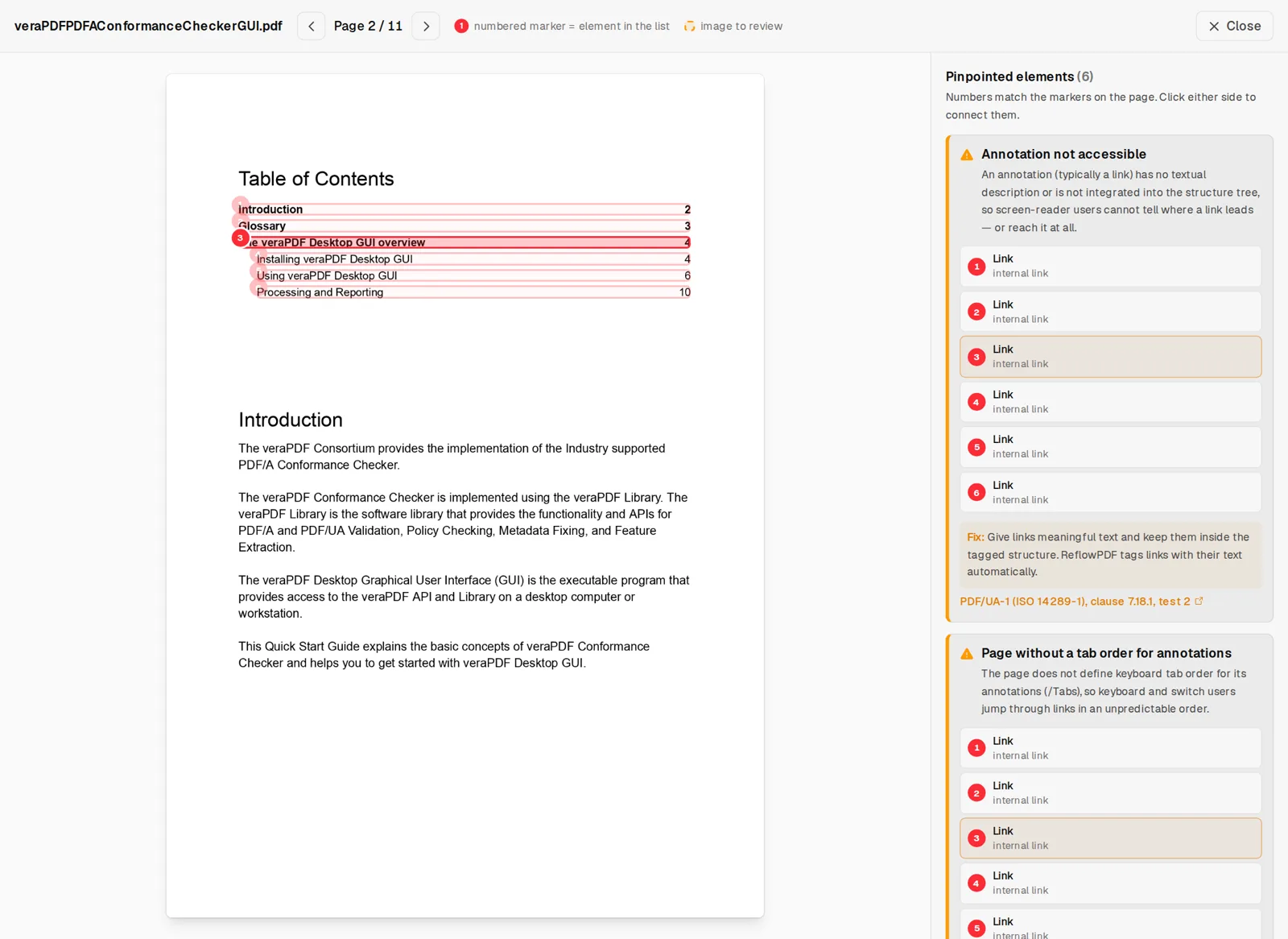
Run locally, veraPDF answers with assertions like clause 7.18.1, test 2: failedChecks: 6 and an XPath-like context for each. Correct — and slow to act on unless you know ISO 14289-1 by heart. The same validation here produces: the rule in plain English, why it matters for a screen-reader user, every affected page, the exact elements marked on the rendered page (a form field by name, a link, an image), how to fix it, and a deep link to the rule’s official description. Plus the part raw output never surfaces well: the rules your document passed, with how many objects were verified.
For developers
The checker is a plain HTTPS endpoint. One request, JSON back — every failed rule with clause/test ids, priorities, affected pages and annotation indexes, plus the passed rules:
curl
curl -X POST https://api.reflowpdf.com/a11y-check \
  -F "file=@document.pdf"
Fair-use limits apply (25 MB per file, a few concurrent checks per client). For high-volume pipelines, run veraPDF’s own CLI on your infrastructure — it’s open source.
veraPDF online — FAQ
What is veraPDF?
veraPDF is the open-source PDF validator originally developed with the PDF Association through an EU-funded (PREFORMA) project. It provides formal validation profiles for PDF/A (archival) and PDF/UA (accessibility), and it's the validator archives, governments and PDF tool vendors use as the reference implementation.
Is this the official veraPDF?
This checker runs the real, unmodified veraPDF engine on our servers — the same validation you'd get from the veraPDF CLI with the PDF/UA-1 profile. The project itself lives at verapdf.org; we're an independent front-end that turns its output into a readable, visual report.
How is this different from running veraPDF myself?
Same verdict, friendlier output. The raw CLI gives you XML/JSON with clause numbers and test assertions. Our report translates every failed rule into plain English, prioritizes it, shows the affected pages with exact element locations drawn on the page, lists what passed (and on how many objects), and links each rule to the specification and the relevant W3C technique.
Which profile does it run?
PDF/UA-1 (ISO 14289-1) by default — the complete machine-checkable rule set, with no rules skipped and no cap on reported failures. You can also select PDF/UA-2 (ISO 14289-2) or Well-Tagged PDF 1.0 before uploading. PDF/A (archival) validation is on our roadmap.
Can I use it from scripts or CI?
The tool is backed by a plain HTTPS endpoint that accepts a multipart file upload and returns JSON. For heavy pipeline use we recommend running veraPDF locally (it's open source); for a quick automated smoke check, the endpoint works with a simple curl call.
What happens to uploaded files?
They're validated in memory and deleted immediately after the check — never stored, never used for anything else. If your documents can't leave your infrastructure at all, run veraPDF locally; that's what open source is for.